Emily’s story: Powering through breast cancer as a busy young doctor

Emily Levy, MD, was in the prime of life. A busy sports medicine specialist at Main Line Health, the mom of three was a lifelong athlete and fitness enthusiast. She grew up cheering for all the Philadelphia sports teams and as the child of two doctors, a career in medicine seemed inevitable.
"When I was in medical school, a family medicine doctor gave a talk about being the physician for the Phillies, and I just thought that seemed like the coolest job," Dr. Levy says. "I didn't really see myself as a surgeon, but doing minimally invasive procedures and providing family medicine support has been a great fit with my strengths and interests."
But while Dr. Levy was leading her best life – eating right, staying active, growing her career and family – cancer was quietly growing on her family tree. It was 2022, and a cousin in her late 30s was diagnosed with stage III colon cancer when Dr. Levy was pregnant with her third daughter. They pieced together other family members who had had cancer, including her cousin's mother, who had had breast cancer in her 40s.
Genetics, screening and cancer diagnosis
"We knew something was going on, but we didn't know what," Dr. Levy says. "We had BRCA testing back then, when that was all you could test. When my cousin went through more sophisticated testing in 2022, we discovered she has the PABL2 gene, which is related to multiple cancers.
"My mother, who never had breast cancer and was in her 70s, then tested positive for the gene. Two weeks after my daughter was born, I tested positive."
Still, she wasn't worried.
"When you haven't had major health issues, you assume everything will be fine. I then had my first mammogram, and I didn't even look at the results. When it came back as abnormal, I was in shock."
She was 38.
Making time for breast cancer
So Dr. Levy went about planning how to work cancer treatment into her already full life. A double mastectomy was followed by chemotherapy and radiation.
"I was raising three kids, including a new baby, and was working," Dr. Levy says. "It was a lot. I am blessed with an incredible spouse who took on a lot of responsibility during that time and really supported me. And my family and friends were my village.
"Between chemo, radiation and a medication that put me into menopause, my energy levels were really low. Sometimes even now I feel so much older than I am."
Struggling to stay active
Falling back on her knowledge as a physician and lifelong fitness habit, Dr. Levy tried to motivate herself to begin exercising.
"Going through cancer and being thrust into menopause, I gained weight and became less active, which was different for me. It gave me a new appreciation into what my patients are going through when they have pain and fatigue."
On some days, fatigue won the battle.
"For two months, I set my alarm to get up early to work out. And for two months, I snoozed the alarm every single day. Sometimes I knew I wasn't going to get up the next morning, and I set the alarm anyway."
Pushing through
Knowing it takes a while to form new habits, she kept trying.
"One day I was able to get up, and I felt so much better after my exercise it motivated me to do it again. There were days when I'd fall off, the kids would get up early or I'd stay up late, but every time I knew I'd feel better again when I got back to it. It becomes this self-starting cycle and gets much easier. Taking that first step was the hardest part.
"I also found an accountability buddy. Sometimes that was the best motivation – even if I could disappoint myself, I knew I wasn't going to disappoint someone else."
Finding motivation on a bike
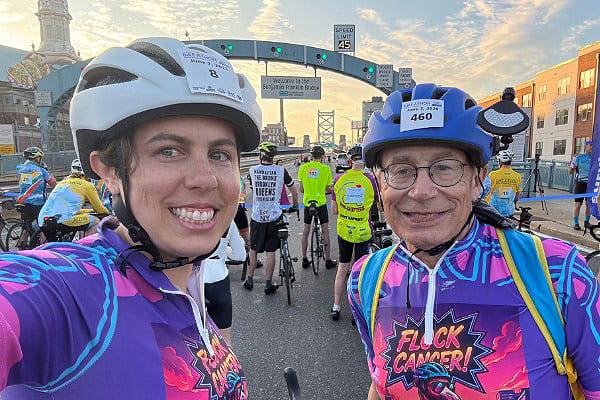
When the idea of taking on the American Cancer Society Bike-A-Thon in 2025 began to emerge, Dr. Levy saw several benefits. The 66-mile ride from the Ben Franklin Bridge in Philadelphia, PA to Ventnor City's beachfront on the Jersey shore has been a fundraiser for the Cancer Society for more than 50 years.
"My brother had done it as a teenager, and my husband had done it," she says. "It became a good motivator for getting up in the morning and doing those bike rides. Raising money for cancer is the ultimate motivator."
Even though it was her first year riding, Dr. Levy was one of the top fundraisers.
"It really speaks to people. There's a lot of fear about these cancer cases in younger people. I lost a close friend to breast cancer on my last day of chemo, and she had no family history of breast cancer. Countless women my age have been diagnosed since I was diagnosed. I think my fundraising was so successful because we're all seeing this and it's really scary."
The ride of a lifetime
Around mile 40, Dr. Levy says she thought, "I didn't die from breast cancer, but I might die from this race."
"It was physically and mentally challenging, especially when we came into the last stretch and were hit by 20 mile-per-hour winds. But I powered through. And it was incredibly emotional crossing the finish line and seeing my family and friends holding signs."
A family affair
This year, when Dr. Levy pushed off from the Ben Franklin Bridge on June 7, her father rode beside her. Her husband and brother rode with her again as well.
Her daughters, now 8, 6 and 4, aren't quite up to the Bike-A-Thon yet, but they do enjoy staying active together with family bike rides and hiking trips. This spring, they hiked and explored White Sands National Park and Carlsbad Caverns in New Mexico.
A new mindset
"Going through cancer changes you. The hardest part was not necessarily during treatment because you buckle down and say, 'I've got to do this,' and you get through it.
"But then when I finished treatment, I realized I have to live my life knowing I had cancer and that there's always a chance I'll have it again. Or that I have to take medicine to prevent it from coming back and that affects my life. That was a really difficult time I wasn't expecting.
"I am in a much better place now than even before cancer because I know life is important. There's only so much you can control. I can't control my genetics, but I can control how my environment interacts with those genetics.
"Staying healthy is important. Prevention is key," says Dr. Levy.
"I got my tubes removed because there's an increased risk of ovarian cancer with my gene. My husband and I have overhauled our diet and how we exercise and it's benefited both of us. Pilates is one of my favorite new activities. I'm much more flexible. I get injured less. I have less aches and pains. It's not just exercise, it's exercise and healing.
"Everyone should be active before you get cancer. But even afterwards, there's still a very fruitful life to be led."
Next steps
Learn more about Emily Levy, MD
Learn more about cancer care at Main Line Health
Learn more about our Genetics and Risk Assessment Program
Related posts
Cancer in young people: What experts want you to know about rising rates
Jessica's story: Genetic testing revealed a lifesaving surprise

Content you want, delivered to your inbox
Want to get the latest health and wellness articles delivered right to your inbox?
Subscribe to the Well Ahead Newsletter.