
Main Line Health Emergency Medical Services
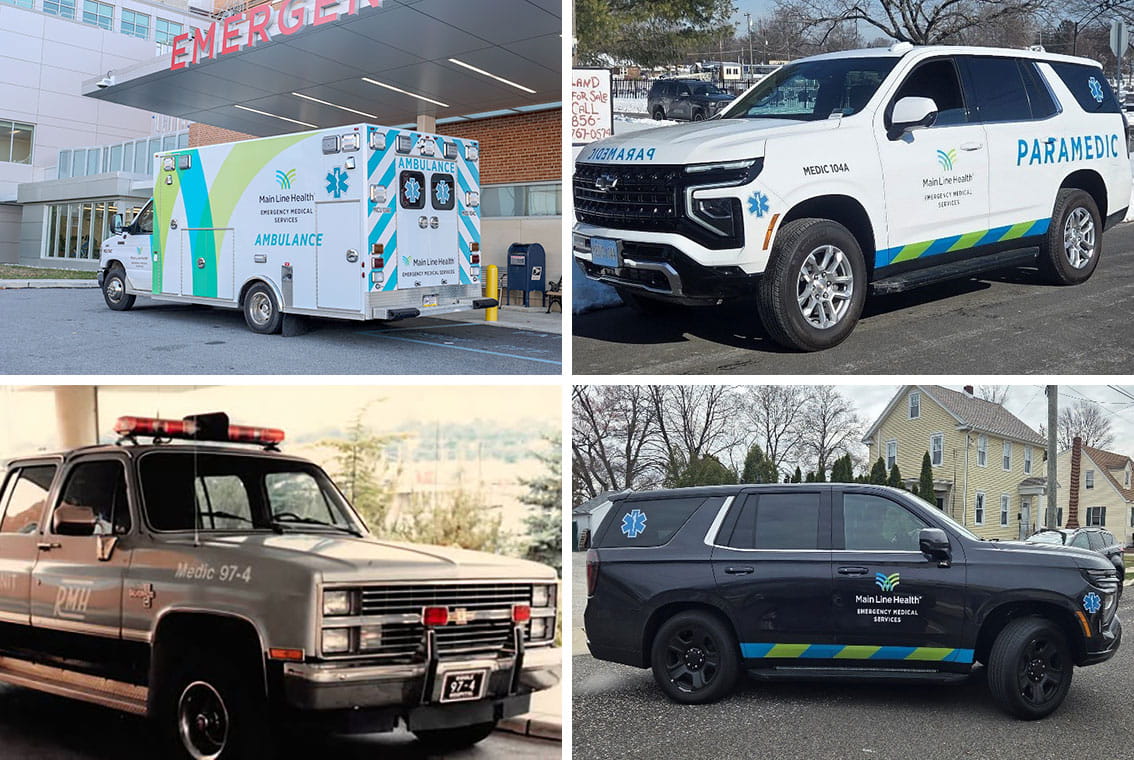
Your health and safety are at the center of everything we do at Main Line Health Emergency Medical Services (EMS). Serving more than 94,000 residents across 12 communities and 64 square miles, we provide fast, reliable 911 emergency medical care you can trust. Our Emergency Medical Technicians (EMTs) and paramedics respond to more than 11,000 calls each year, offering skilled treatment, reassurance and lifesaving support whenever and wherever you need help. Because caring for our community is at the heart of what we do.
Advanced Life Support (ALS)
ALS is the highest level of pre-hospital medical care we provide.
Our ALS ambulances — also called Mobile Intensive Care Units (MICUs) — are licensed by the Pennsylvania Department of Health. Each unit is staffed with one paramedic and one EMT.
Paramedics have advanced training that allows them to:
- Read and interpret heart monitors (ECGs)
- Provide external pacing, cardioversion and defibrillation
- Perform advanced airway procedures, including placing breathing tubes
- Start IVs and give fluids
- Administer more than 25 medications to treat heart attacks, cardiac arrest, breathing problems, allergic reactions, and other emergencies
ALS Squads — also known as “chase cars” — are non-transport vehicles staffed by a paramedic. Their role is to:
- Bring advanced care to a scene when needed
- Assist Basic Life Support (BLS) ambulances
Some ALS units include a Paramedic Supervisor who can assist with critically ill patients and help manage complex emergencies.
Basic Life Support (BLS)
BLS ambulances are staffed with two EMTs trained to provide essential emergency care. EMTs can:
- Assess and monitor patients
- Provide oxygen and approved medications
- Stabilize broken bones
- Use an automated external defibrillator (AED)
- Perform cardiopulmonary resuscitation (CPR)
- Manage basic airways using special devices
BLS ambulances transport and care for patients who do not require advanced medical procedures.
Mobile Integrated Health (MIH) and community paramedicine
MIH is a growing program designed to bring care to patients outside the hospital and reduce unnecessary 911 calls and visits to the emergency department when appropriate. MIH teams — often made up of community paramedics and other clinicians — provide:
- Patient-centered, at-home or on-site care
- Help managing chronic conditions
- Support between doctor visits
- Connections to community resources
This model helps make sure patients receive the right care, at the right time, in the right place.
Community paramedicine
Community paramedicine is part of MIH and utilizes specially trained EMS clinicians to:
- Provide non-emergency care
- Improve access to services
- Help patients manage health needs safely at home
Delaware County Overdose Response Team (DCORT)
DCORT is a special Mobile Integrated Health service focused on helping people affected by substance use disorders (SUD). Each team includes a:
- Community paramedic — Ensures the patient is medically stable, provides emergency care if needed and supports entry into treatment.
- Certified Recovery Specialist (CRS) — A person in long-term recovery who offers peer support, encouragement and guidance for individuals seeking treatment.
Together, they provide compassionate care and help connect patients with recovery resources.
Interfacility transport: Routine Transport Services (RTS) unit
Main Line Health EMS also offers non-emergency transportation through our RTS unit. This ambulance is staffed by two EMTs and helps move patients:
- Between hospitals and other care facilities
- To medical appointments
- Back home after discharge
This service plays an important role in helping patients safely transition to the next step in their care or recovery.
Contact us
For questions about our services, programs or partnerships, contact us at emschief@mlhs.org.